360 Fighter Victories: SECRET
A Secret Wartime RAF Report
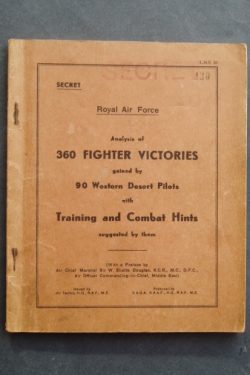
Royal Air Force
Analysis of 360 Fighter Victories Gained by 90 Western Desert Pilots
with Training and Combat Hints suggested by them
Stamped SECRET copy 430
An original RAF Secret orange card cover booklet of approximately 50 pages issued by Air Tactics HQ RAF Middle East in 1943.
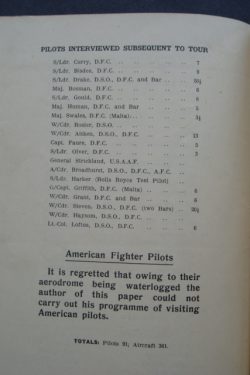
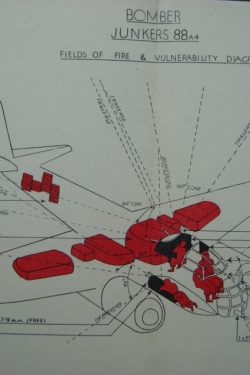
It is in Fine condition, remarkably well preserved for it’s age. There is a preface by ACM Sholto Douglas followed by pages of data, analysis, lists of pilots interviewed plus practical advice There are 9 large pull out pages detailing the fields of fire and vulnerabilities of the Luftwaffe and Regia Aeronautica aircraft most often encountered (Me 109, 110, 210, Ju 87, 88, Mc 202, He 111, Fw 190, Sm 79).
An exceptionally rare primary source wartime document not currently available anywhere outside of the National Archives.
Background and Historical Importance
Titled ‘Analysis of 360 Fighter Victories Gained by 90 Western Desert Pilots’, this official report is one of the earliest data-driven studies dissecting the cold mechanics of aerial combat. In the harsh conditions of the desert, where Allied pilots in Hurricanes, Tomahawks, Kittyhawks, and Spitfires clashed with the German Luftwaffe and Italian Regia Aeronautica, the Air Ministry sought quantitative data to replace romanticized notions of the ‘dogfight.’
Historically known as Report No. 63 by the Air Ministry Operational Research Section, this is a seminal piece of pioneering British military evaluation. By stripping away the mythology of the WWI Ace and treating the fighter aircraft as a weapon system operating in a statistical space, this report fundamentally transformed how air wars were understood. It showed that aerial combat was not a series of chivalric duels, but an exercise in situational awareness, positioning, and ambush.
The ORS compiled exhaustive combat debriefs, camera gun footage, and intelligence reports from 90 individual fighter pilots who accounted for a combined total of 360 confirmed aerial victories. Rather than evaluating the pilots’ bravery, the researchers coded concrete operational variables across every single engagement.
By focusing strictly on 360 confirmed victories across a diverse sample of 90 pilots, the report eliminated anecdotal bias and therefore had empirical integrity. It was also objective in that it looked at the mechanics of destruction rather than heroism. However, because the data was harvested strictly from successful victories achieved by surviving pilots, the document naturally lacks the counter-data: the tactical mistakes made by the hundreds of Allied pilots who were shot down in the Western Desert.
The publication had an immediate and profound impact on RAF training and tactical doctrine, particularly in gun sight harmonisation and in situational awareness training, shifting the focus of fighter pilot training away from complex aerobatics and heavily towards scanning techniques, keeping a clean tail, and mastering the art of the unseen approach.
Above all, this booklet remains an invaluable archival artefact for military historians and tactical analysts. It marks the precise historical point where the air forces of the world realized that data and statistical analysis were just as vital to achieving air superiority as engineering, horsepower, and pilot courage.