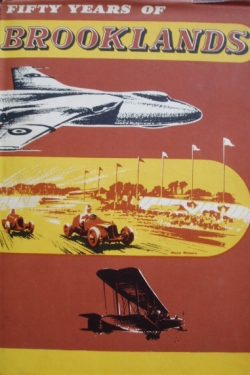
FIFTY YEARS of BROOKLANDS
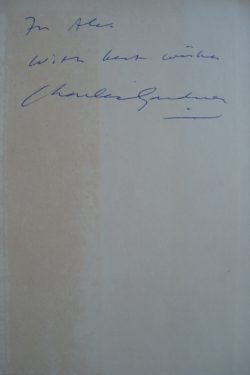
Signed by Charles Gardner
Presentation to aviation author and Spitfire pilot Alec Lumsden from
the author, distinguished broadcaster and Catalina pilot, Charles Gardner
Heinemann First edition 1956. 160 pages and well illustrated with photographs.
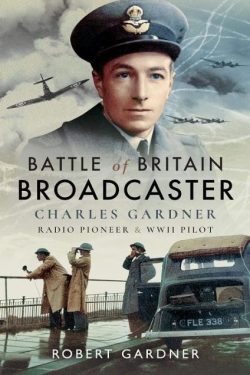
Fine condition hardback book and Fine condition unclipped dustjacket. Clean, tight and bright with some light offsetting to the front and back end papers. A very pleasing copy. NB the biography of Gardner shown above is for illustrative purposes and is not included.
Edited by Charles Gardner, this was the first complete account of the famous racing track and aerodrome which was the birthplace of two great British industries; motoring and aircraft. It was on these few acres tucked away in a corner of Surrey that AV Roe’s first machine took to the air and it was on the banked circular track that pioneers sought ever higher speeds in various wheeled contraptions. From early flights of a few yards to commercial jet airliners; from the earliest motors to sleek modern cars, Brooklands has witnessed staggering advances and this book tells its unique story.
Charles Gardner (1912–1981) was a true pioneer of radio broadcasting, a decorated wartime pilot, and one of the defining voices of the BBC during World War II. Along with Richard Dimbleby, he established the very foundation of modern field journalism. With the outbreak of WWII, he became one of the first official BBC war correspondents, initially embedded with the RAF’s Advanced Air Strike Force (AASF) in France. His defining career moment occurred on 14 July 1940 on the white cliffs of Dover. Armed with a heavy mobile recording unit, Gardner caught a surprise attack by German Stuka dive-bombers targeting a British convoy in the English Channel. Standing near an anti-aircraft gun, he delivered a breath-taking, raw, 9-minute eyewitness commentary as RAF Hurricanes and Spitfires intercepted the Germans. The historic Dover audio clip became iconic. It was a massive morale booster that proved to the public that the RAF could successfully fight off the Luftwaffe.
Late in 1940, Gardner decided to leave the microphone behind to join the action directly. He was commissioned as an RAF pilot and spent the war flying Catalina flying boats for Coastal Command over the Atlantic and later around Ceylon. Recognizing his communication skills, Lord Mountbatten personally recruited Gardner to help report and document the exploits of the British 14th Army fighting in Burma. After the war, Gardner returned to the BBC from 1946 to 1953 as its official Air Correspondent, earning the nickname “The Voice of the Air” while documenting the post-war golden age of British aviation. He eventually left broadcasting to lead public relations for the British Aircraft Corporation, where he worked closely with aerospace legends during the development of aircraft like the Concorde.
Alec Lumsden was born in 1921 and enlisted in the RAF Volunteer Reserve on the outbreak of World War II. His wartime flying was varied, he flew Spitfire combat missions from bases in England, North Africa and Malta; he also participated in two Atlantic convoys as the pilot of a Sea Hurricane I attached to the Merchant Ship Fighter Unit. Slightly wounded during a bombing raid on Malta in July 1942, he spent the rest of the war flying with Maintenance and Operational Training Units. Post-war, he had jobs in aviation including route manager for Silver City Airways, chief information officer at Hawker Siddeley, editor at Interavia magazine, and press officer at BAC. An aviation historian of considerable note, he wrote countless articles and several books.