SCHNEIDER TROPHY
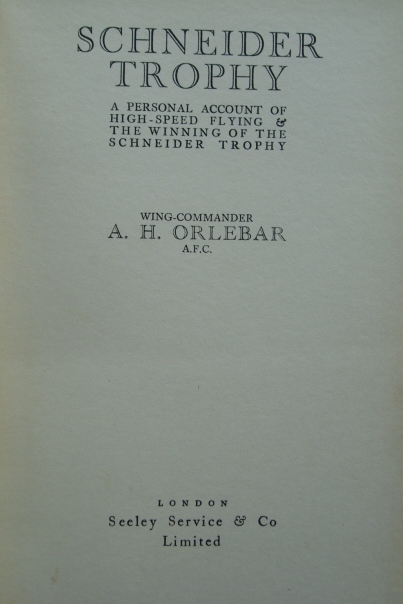
By Wing Commander A H Orlebar AFC
Sold
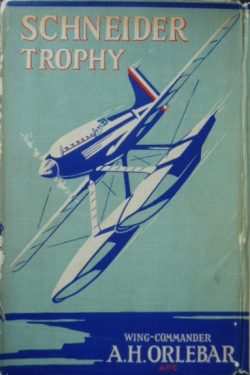
An exceptionally rare first edition of ‘Schneider Trophy’ with striking dust jacket
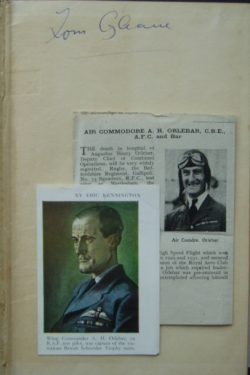
Signature on the front end paper of Group Captain Tom Gleave, OC 253 Squadron Battle of Britain
and RAF Historian, perhaps indicating that this book at some point belonged to him.
With laid in ephemera about Wg Cdr Orlebar
A Near Fine condition hardback book in dark blue boards with titles to the spine. The book is clean, bright, square, solidly bound with just a very small amount of light scattered spotting to the blank pages. The very rare dustjacket is in Very Good condition, clipped, with just a small amount of edgewear to the top and bottom of the spine which does not affect the titles. There is another small ownership signature dated 24/2/42 on the blank pre-half title page.
Wing Commander Orlebar was the CO of the RAF High Speed Flight and Captain of the Schneider Trophy Team in 1929 and 1931 contests. Written from notes made whist the author was preparing for the contests, this book covers the training of the selected pilots and gives a vivid account of the preparation for and conduct of the races. A fascinating account of how Britain came to win outright the coveted Schneider Trophy by the man who was ultimately responsible.
This is an exceptionally scarce book even without the striking dustjacket and would be a superb addition to any aviation collection.
Spitfire Books has an Augustus Orlebar signature available – please enquire.
See also: A Schneider Trophy 40th Anniversary Cover signed by Team Members Schneider Trophy – Spitfire Books
The Schneider Trophy
The first contest for the Schneider Trophy was no more than a single and apparently minor item in a 14-day hydro-aeroplane meeting at Monaco in April 1913; yet within ten years it had become the most coveted of all air prizes, the greatest international speed race of all time. Dominated at first by France, it was very nearly won outright by Italy – three wins in five years was what was required – in the years immediately after the first World War.
A flying-boat modified by a young man named R. J. Mitchell saved the trophy at Naples in 1922, but in 1923 the Americans, fielding a well-trained military team and flying the incomparable Curtiss racer, outclassed all their rivals and carried off the trophy. Winning again at Baltimore in 1925, they seemed certain to capture the prize outright. But then came the Italians’ greatest moment as the firms of Macchi and Fiat achieved the miracle of producing in seven months a new monoplane which defeated the seemingly unbeatable Curtiss biplanes at Hampton Roads, Virginia.
A British victory at Venice brought the contest to England in 1929 for the first time for six years, and a thrilling race in which a new Supermarine design was powered for the first time by a Rolls-Royce engine ended in another British victory. The political, technical and economic background to the challenges of the various countries had been a fascinating one throughout, and now the need for economy decided the British Government against further official participation – a decision already taken by the United States.
How Lady Houston kept Britain’s chances alive with a gift of £100,000, and how Britain finally secured the trophy, makes a dramatic climax to a unique story of human progress and endeavour. Britain’s success in the 1929 and 1931 events was due largely to a new Supermarine design powered by an equally innovative Rolls-Royce engine. A few years later this combination gave birth to a fighter aircraft named the Spitfire.
Air Vice-Marshal Augustus Orlebar CBE AFC* (1897-1943)
Augustus Henry Orlebar was a British Army and Royal Air Force officer who served in both world wars. He was the Commanding Officer of the RAF Team that won the 1929 and 1931 Schneider Trophy races for Britain.
After being wounded during the Gallipoli campaign he joined the Royal Flying Corps. He was posted to 19 Squadron RFC on the Western Front. On 13 March 1918 he shot down Lt. Lothar von Richthofen (brother of Manfred von Richthofen), near Cambrai. He was credited with 2 enemy aircraft destroyed whilst serving with 19 and a further four as a flight commander in 73 Squadron, before being wounded. He gained his final victory with 43 Squadron on 29 September, bringing his total to 7.
Between the wars he was a test pilot and then was appointed Officer Commanding and pilot with the High Speed Flight, the RAF’s team for the Schneider Trophy seaplane races of 1927-1931. Britain, having won the 1927 race, became the subsequent host for the contests, which were based at RAF Calshot on Southampton Water.
In 1929 he set an air speed record of 357.7 mph in Supermarine S.6 N247
By the outbreak of the Second World War he was in command of RAF Northolt. He briefly became Director of Flying Training in 1940 before going to HQ RAF Fighter Command. In July 1941 he became Air Officer Commanding, No. 10 (Fighter) Group, and in March 1943 Deputy Chief of Combined Operations. He fell ill, and died in hospital on 4 August 1943.