HAWKER – GRIEVE Souvenir 1919
Harry Hawker ~ Kenneth Mackenzie-Grieve
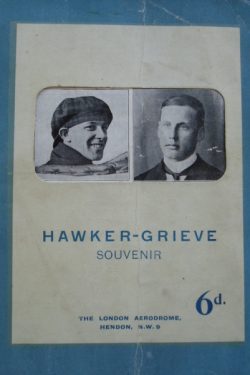
Original 1919 publication
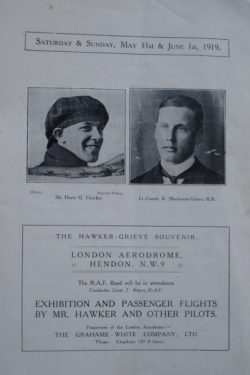
An original and exceptionally scarce programme from 1919
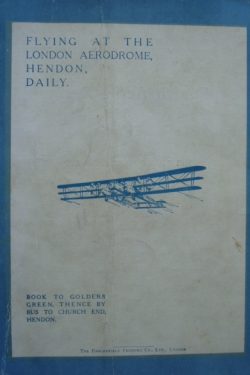
A 12 page booklet with card covers produced by The Grahame-White Company in very quick time in May 1919. It contains an account of the flight as told by Harry Hawker and reprinted from ‘The Daily Mail’; a description of the Sopwith Atlantic with photographs; biographies of Hawker & Mackenzie-Grieve; details of the Daily Mail Atlantic prize and details about flying at Hendon with flights from one guinea! There are currently no other copies available.
The programme is in extremely good condition, considering its age, with just some light creasing and rubbing. A remarkable survivor.
On 18 May 1919 Australian pilot Harry Hawker, chief test pilot for the Sopwith Aviation Company and navigator K. Mackenzie Grieve, an officer in the Royal Navy, launched the world’s first non-stop transatlantic flight attempt. Chasing a £10,000 Daily Mail prize, they took off from Mount Pearl, Newfoundland, in a single engine Sopwith Atlantic biplane, designed by Tom Sopwith.
Realizing they could not reach Europe, Hawker diverted toward active North Atlantic shipping lanes. After 14.5 hours in the air, they successfully ditched the machine in the rough sea alongside the Danish freighter Mary. Because the small merchant ship lacked a wireless radio, the aviators could not transmit news of their survival. For six agonizing days, they were presumed dead, prompting King George V to send condolences to their families.
When the Mary finally reached Scotland, the world learned of their miraculous survival. Despite failing to finish the crossing, they returned to London as national heroes, receiving the Air Force Cross and a £5,000 consolation prize for their extraordinary bravery.
The meeting at the London Aerodrome, Hendon, on May 31st and June 1st, 1919, was a massive public victory celebration held to honour Harry Hawker and Kenneth Mackenzie Grieve. Just four days after their miraculous return to London on May 27th, the aerodrome hosted a massive two-day event featuring flying displays by Hawker to toast what the public viewed as “British pluck”.
The weekend was marked by two major historical events:
- A Historic Intersection: On Saturday, May 31st, while the crowds at Hendon were celebrating Hawker and Grieve’s survival, news broke that American Lieutenant Commander Albert Cushing Read and his crew had just landed the US Navy NC-4 flying boat in Plymouth. This made them the first team to officially fly across the Atlantic (albeit via a multi-stop route). Commander Read subsequently made his way to Hendon over the weekend to personally meet Hawker, creating a historic moment where the world’s most famous transatlantic pioneers stood together.
- The Public Tribute: Massive crowds packed into Hendon to watch Hawker perform aerobatic displays. Because the public had spent six days believing the duo had perished at sea, the mood was ecstatic. The event solidified Hawker and Grieve as international celebrities, serving as a prelude to their formal reception at Buckingham Palace where King George V awarded them the Air Force Cross.
Sadly, Hendon Aerodrome would also mark the final chapter of Hawker’s life; just two years later, he tragically died in an aircraft crash nearby while practicing for the Aerial Derby.
Despite its failure, this pioneering flight was an enormous feat of courage and airmanship. This is a remarkable souvenir of the first attempt to fly across the Atlantic, which thousands of air passengers now do every day without a thought for these brave pioneers.